What’s in a name? The debate over renaming cities and landmarks | India News


You are travelling on Delhi Metro’s Blue Line. The train slows down. A familiar announcement echoes through the coach: “Agla station hai… Supreme Court.”On the display board, it still reads in Hindi: “सुप्रीम कोर्ट.”For most commuters, it is just another stop. For a few, it sparks a question. If the country’s highest court is officially referred to in Hindi as “ Sarvochh Nyayalaya,” why does the station continue to use the English name? Think about it. How often do you still call Varanasi by its older, more familiar name—Banaras? Or refer to Prayagraj as Allahabad in everyday conversation? The instinct is almost automatic. Names, after all, are more than administrative labels; they are memories, habits and histories rolled into a single word.Each renaming brings with it fresh signage, updated records and official notifications. But while governments can issue gazette notifications overnight, public memory rarely updates at the same pace. This results in creating a visible overlap of the past and the present, where old names continue in conversation and memory, even as new ones appear on official boards, documents and public announcements.
From Seva Teerth to metro maps: How a name is reshaping public space and law
In the heart of the capital, a name change has sparked public discussion, policy attention and administrative implications.Following the renaming of an iconic complex as Seva Teerth, discussions have also extended to process, precedent and legality that have reached the Supreme Court.On February 13, Prime Minister Narendra Modi unveiled the name Seva Teerth for the new building complex housing the Prime Minister’s Office, the National Security Council Secretariat and the Cabinet Secretariat. He formally inaugurated Seva Teerth and Kartavya Bhavan-1 & 2 and addressed a public programme the same evening.
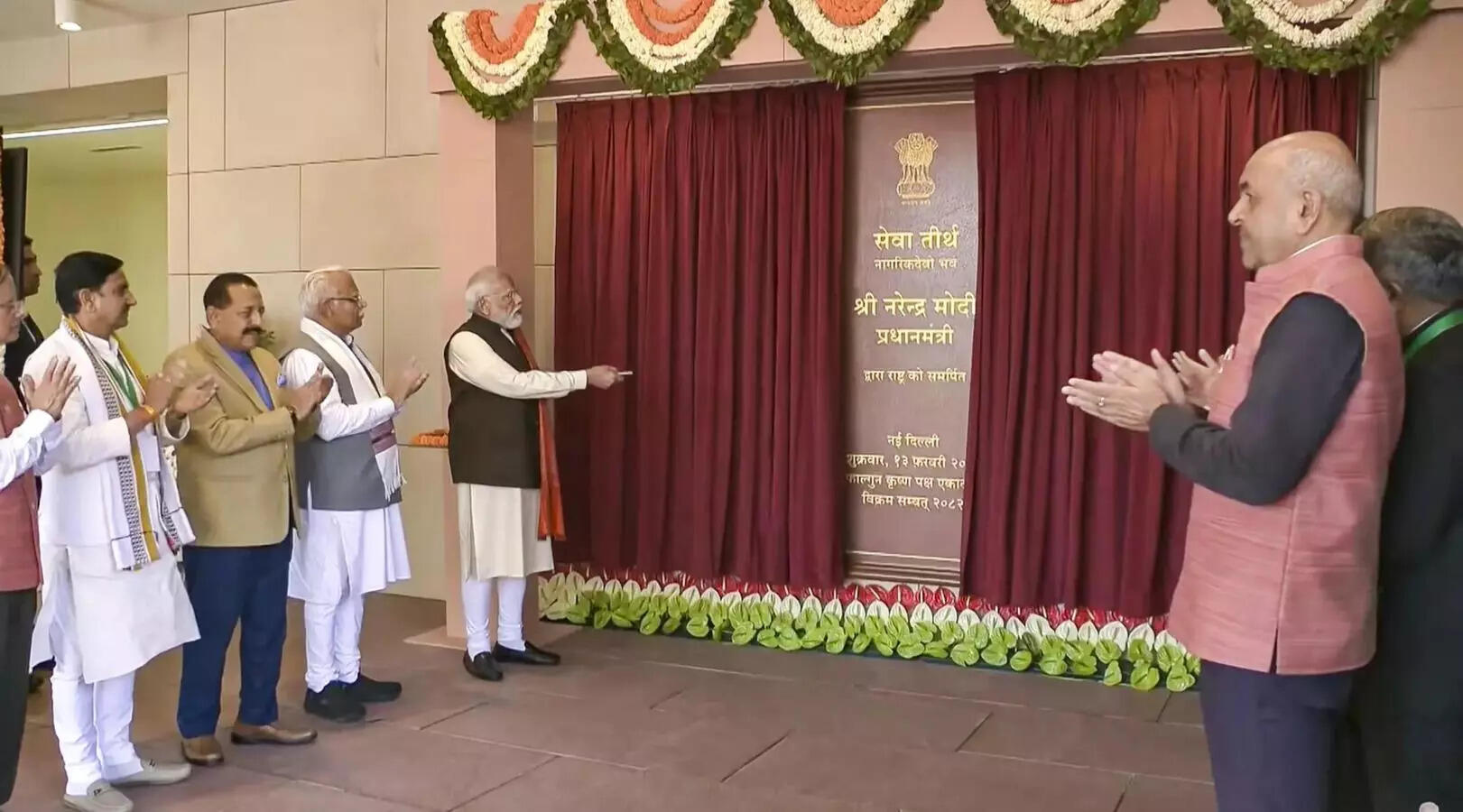
The government described the inauguration as “a transformative milestone in India’s administrative governance architecture,” stating that the new complexes consolidate ministries that were earlier functioning from fragmented and ageing infrastructure across the Central Vista area.Kartavya Bhavan-1 and 2 accommodate key ministries including Finance, Defence, Health & Family Welfare, Corporate Affairs, Education, Culture, Law & Justice, Information & Broadcasting, Agriculture & Farmers Welfare, Chemicals & Fertilizers and Tribal Affairs.Addressing the gathering, PM Modi said: “Today we all are witnessing a new history being made… This day of 13th February is witnessing a new beginning in India’s development journey… Today, we are all entering Seva Teerth and Kartavya Bhavan with the resolve to achieve ‘Viksit Bharat’. We have the divine blessings of achieving our goals.”

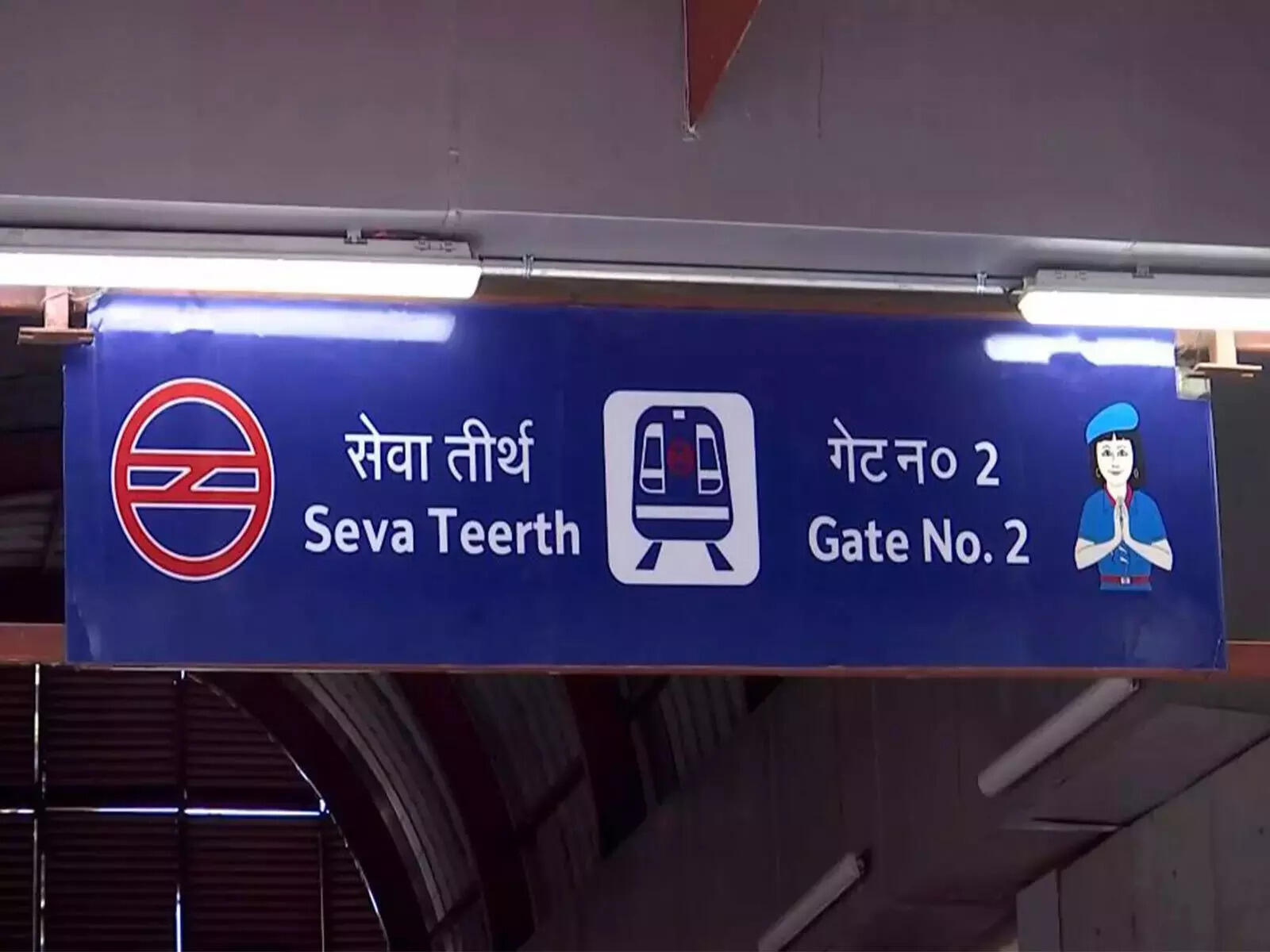
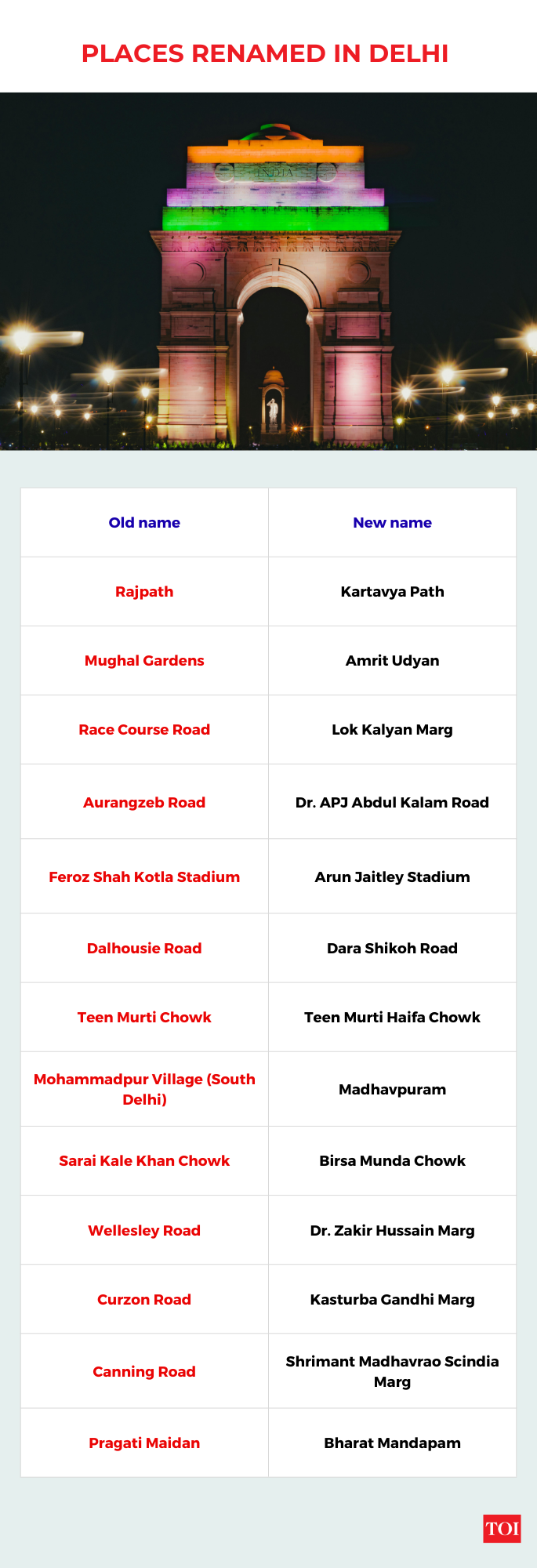
A day after the unveiling of the PMO complex, the Udyog Bhawan Metro Station on the Yellow Line was renamed Seva Teerth. The station lies beside Lok Kalyan Marg (earlier called Race Course) and serves lakhs of commuters across the capital.The renaming aligns with the government’s broader move since 2014 to shift away from colonial-era nomenclature. Over the years, Race Course Road became Lok Kalyan Marg, Rajpath became Kartavya Path and other similar changes were introduced.
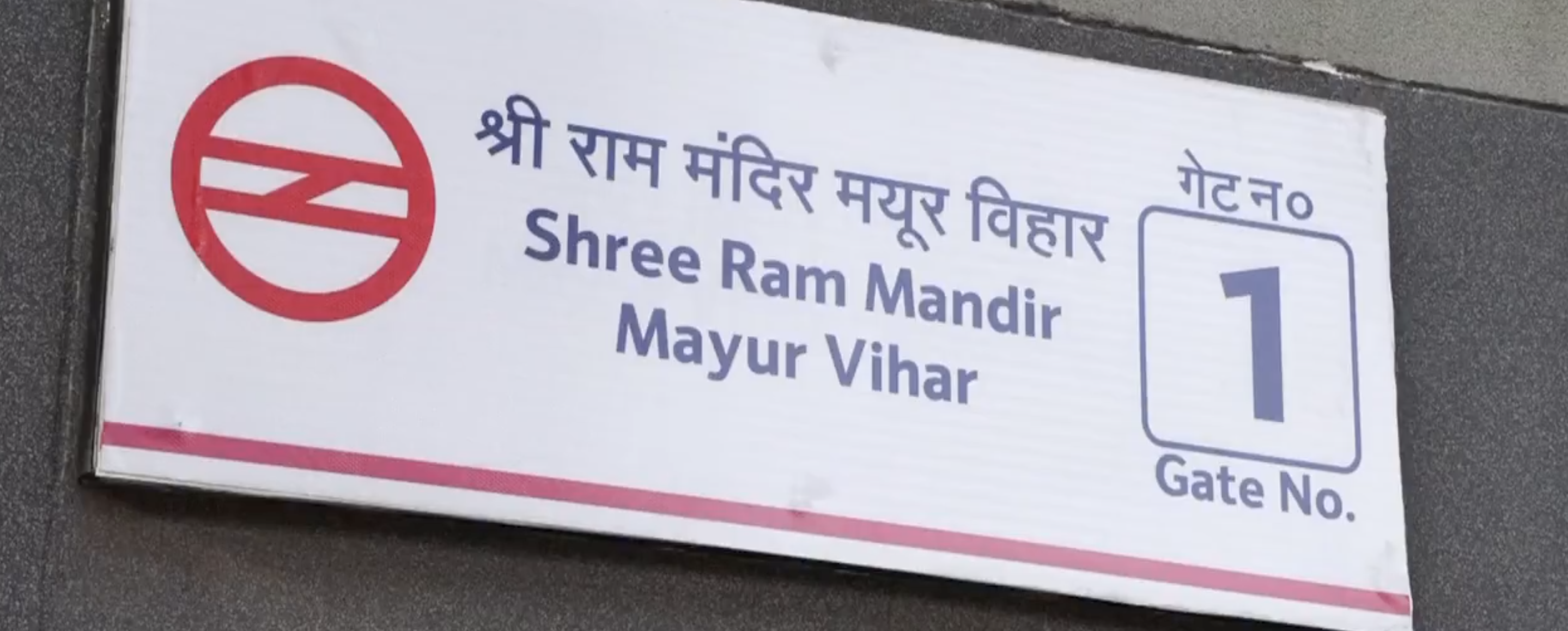
Another recent example is the Mayur Vihar Pocket 1 Metro Station, now renamed Shree Ram Mandir Mayur Vihar. The station, located on the Pink Line, connects major transit points including Anand Vihar Railway Station, Rajouri Garden and Lajpat Nagar.Explaining the decision, a local resident and Sanatan Dharm Sabha patron Govind Singh Pawar said: “People used to get confused between Mayur Vihar Phase 1 and Mayur Vihar Pocket 1. The BJP government, which promotes Sanatan Dharma, has corrected this. The people are very happy with this decision.”
.
“I don’t really see any harm in changing metro station names. But yeah, it can be confusing for people who don’t travel every day. Someone who visited Mayur Vihar Pocket 1 earlier might struggle to find it again on the map after the name change. It’s a small issue though, people will get used to it over time. Mayur Vihar connects to Noida and Ghaziabad, so many students and working professionals live here, and I don’t think this will affect their daily lives much,” a local resident said.
A plea before the Delhi high court seeks to designate the Hindi name of the Supreme Court Metro Station as ‘Sarvochh Nyayalaya’ instead of simply writing ‘Supreme Court’ in Devanagari script.Advocate Umesh Sharma, who filed the petition, told the court: “The Metro station had been named ‘Supreme Court’. We demanded that its name be ‘Sarvochh Nyayalaya’… On the Supreme Court’s board and website it is written as ‘Sarvochh Nyayalaya’.”He argued that under the Official Languages Act, 1963, Hindi in Devanagari script must be used appropriately and that merely transliterating the English term does not fulfil the mandate.Appearing before the Delhi high court, the Delhi Metro Rail Corporation (DMRC) opposed the plea, citing financial and operational concerns. Counsel for DMRC submitted: “It comes as a financial burden. One such change is 40-45 lakh per station… It will involve a change in the roadmap. It’s a PSU and the public’s money.”The corporation also warned of a potential ripple effect, stating that similar litigations could follow if the change were allowed.However, the court observed: “Multiple litigation is not (the defence). We have to honour the act.”It directed the Centre and the DMRC to file affidavits, keeping in view the Official Languages Act, 1963 and the Official Languages (Use for Official Purposes of the Union) Rules, 1976.
The law behind a name: What the Constitution says on renaming?
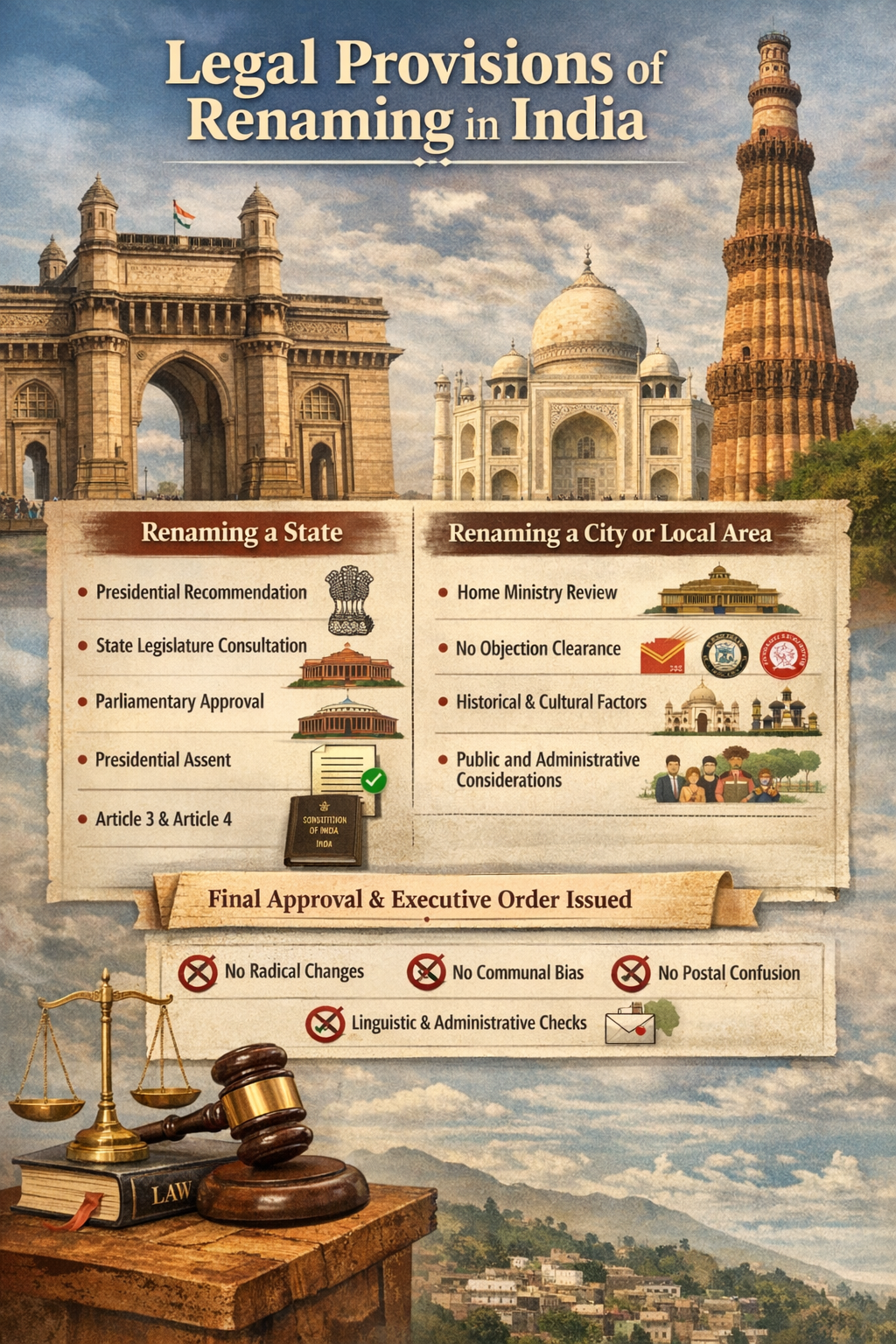
The legal framework governing the renaming of places in India differs depending on whether the change involves a state or a city/local area. The Constitution lays down a clear procedure for states, while cities are guided by legislative powers and central guidelines.The Constitution of India provides for the renaming of a state under Article 3. It empowers Parliament to form new states and alter the areas, boundaries or names of existing states by law.Under this provision:
- A bill for renaming a state can be introduced in Parliament only on the recommendation of the President.
- Before the bill is introduced, the President refers it to the concerned State Legislature to express its views within a specified period.
- The views of the State Legislature are not binding on Parliament, but they must be taken into consideration.
- The bill must be passed by a simple majority in both Houses of Parliament.
- After passage, the bill is sent to the President for approval, and upon assent, it becomes law.
Article 4 complements Article 3 by enabling Parliament to make consequential amendments necessary to give effect to such changes.
.
The procedure for renaming a state can be initiated either by Parliament or by a State Legislature passing a resolution and sending it to the Central Government for approval. The Central Government then introduces the bill in Parliament after obtaining the President’s recommendation.At the central level, the proposal is examined by the ministry of home affairs in consultation with concerned agencies. Approval is granted only after obtaining no objections from:
- The Department of Posts
- The Survey of India
- The Ministry of Railways
These agencies confirm that there is no other village, town or city with a similar name in official records that could create administrative confusion.The Central Government considers factors such as:
- Historical significance
- Public sentiment
- Linguistic affinity
- Administrative convenience
- National integration
Guidelines issued in 1953 further state that:
- The change should not involve a radical alteration but may allow phonetic correction or transliteration.
- It should not be based on communal or sectarian considerations.
- It should not create confusion for postal, railway or other services.
- It should not adversely affect the interests of any other state or union territory.
After scrutiny and approvals, an executive order is issued formalising the renaming.
The administrative cost: What renaming entails
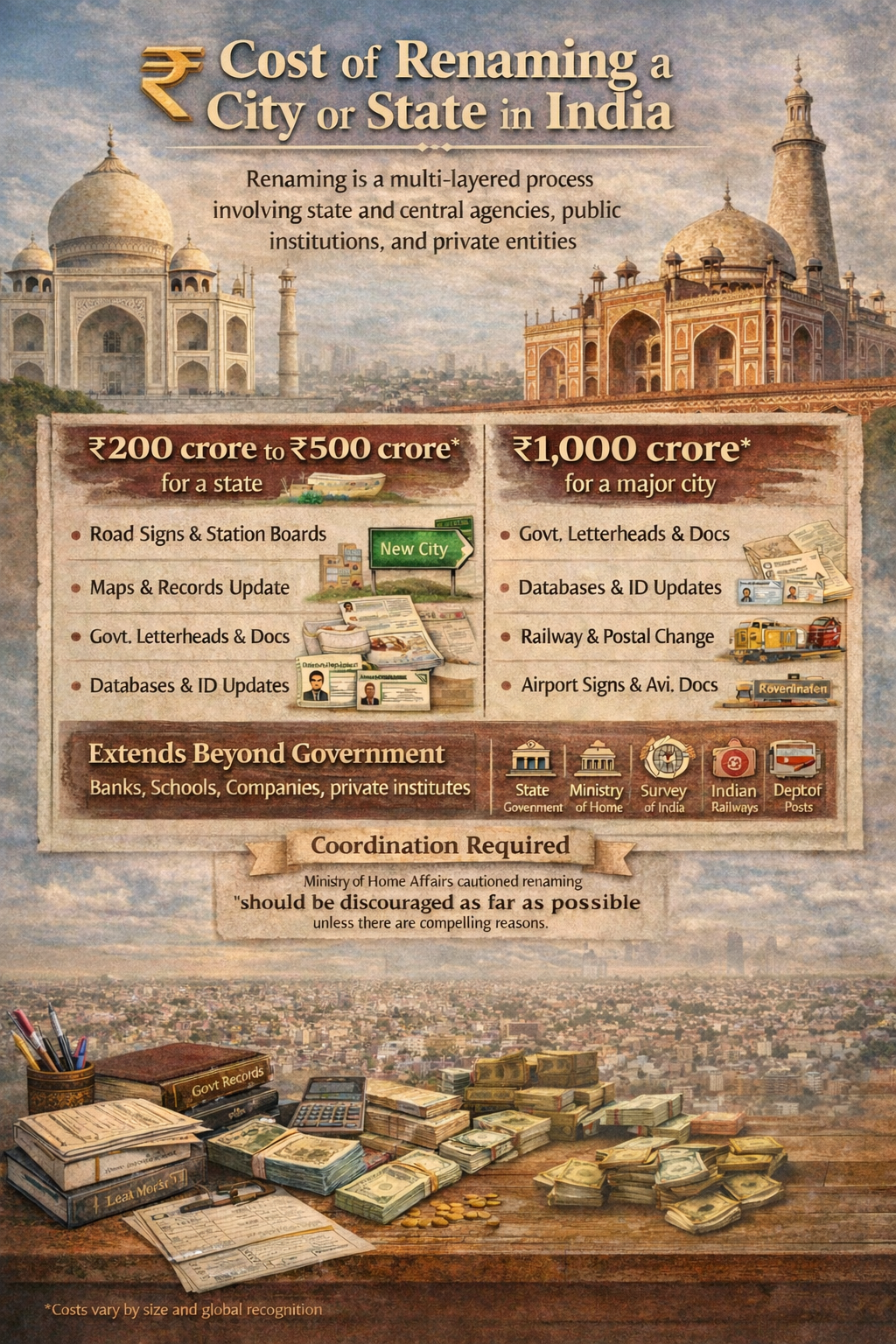
Renaming a city or state is not limited to replacing a signboard — it triggers a multi-layered administrative overhaul involving state and central agencies, public institutions and private entities.The material shows that the cost of renaming a city or state can range from Rs 200 crore to Rs 500 crore, depending on its size and global recognition. In the case of a major city, estimates suggest that the figure can go up to Rs 1,000 crore.
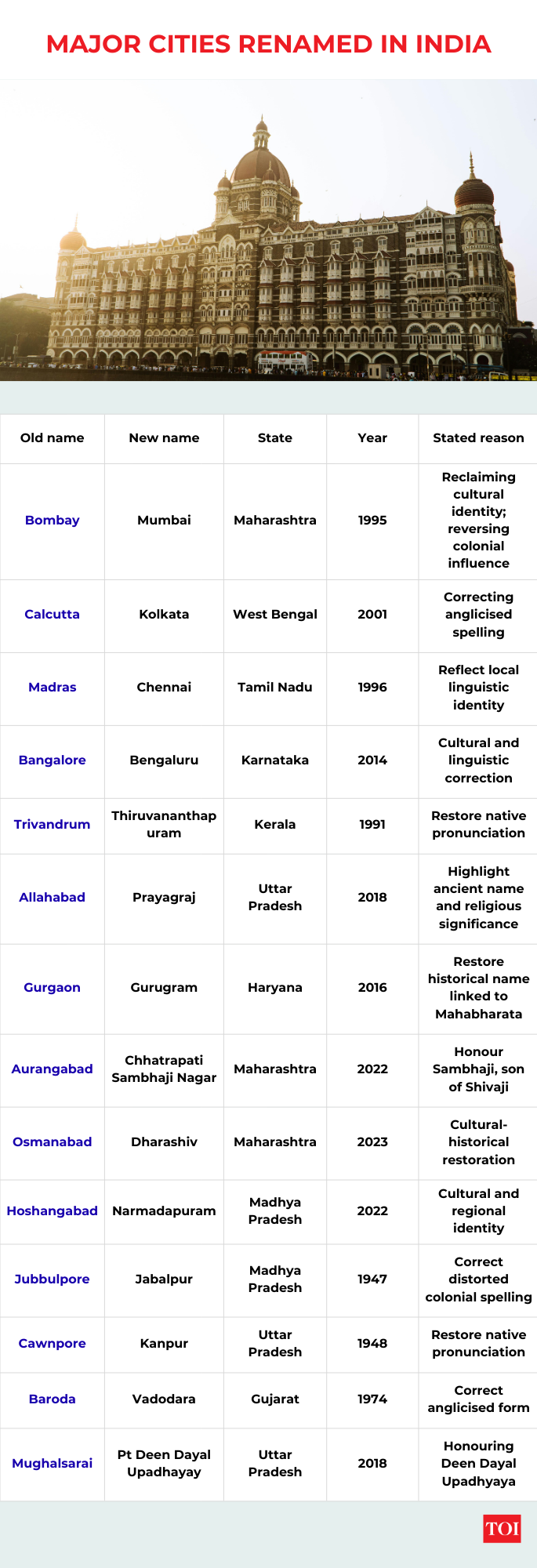
- The renaming of Allahabad to Prayagraj reportedly cost over Rs 300 crore, according to government estimates.
- The Indian Railways spent Rs 2.5 crore to change Bombay to Mumbai on signboards, tickets and timetables in 1995.
- Using a revenue-based estimation model, the projected cost of renaming India to Bharat was calculated at approximately Rs 14,304 crore, according to government of finance.
The expenditure typically covers:
- Updating road signage, highway markers and railway station boards
- Revising official maps and land records
- Changing government stationery and departmental documentation
- Modifying databases across ministries and civic authorities
- Updating railway tickets, timetables and postal records
- Adjusting airport signage and aviation documentation
- Changes to Aadhaar, passports, voter IDs and other official records
Beyond government departments, private institutions like banks, schools, businesses and corporate houses must also update their records, branding and promotional material. This involves both direct expenditure and indirect administrative costs.
.
The process requires coordination between the State Government, the Ministry of Home Affairs, the Survey of India, the Railways and the Department of Posts. Government guidelines have historically outlined considerations for renaming proposals. For instance, a 1953 Ministry of Home Affairs communication noted that it “should be discouraged as far as possible unless there are compelling reasons,” observing that such changes create confusion and administrative burden.
The material also highlights that renaming affects not only local systems but district, state, national and even international documentation. In a country as large and diverse as India, this coordination significantly increases logistical complexity.
Identity, impact and the Supreme Court: Advantages, challenges and the 2023 ruling
Renaming a place is driven by multiple factors. The rationale behind renaming includes:
- Rapid urbanisation, with India projected to add 416 million people to cities by 2050, requiring new infrastructure and names.
- Reclaiming identity by correcting anglicised or distorted spellings imposed during colonial rule.
- Honouring national leaders, martyrs and culturally significant figures.
- Asserting linguistic and cultural identity of regions.
- Political repositioning and symbolic shifts in public memory.
Supporters argue that renaming can:
- Instil pride, dignity and a sense of belonging among residents
- Preserve and revive cultural heritage and civilisational consciousness
- Correct historical distortions in spelling and pronunciation
- Shape the values inscribed in public space
- Build a distinctive brand identity that may attract tourism and investment
On the loop side there can be several challenges associated as well:
- Confusion in a global economy once a city has achieved international recognition
- Administrative inconvenience and extensive paperwork updates
- Economic strain due to large public expenditure.
- Emotional and cultural resistance from residents accustomed to older names
- Risk of social division and political polarisation
- Possible erosion of historical continuity and public memory
In 2023, the Supreme Court dismissed a Public Interest Litigation seeking the formation of a renaming commission focused on “ancient India” and restoration of names allegedly altered by “barbaric invaders”.
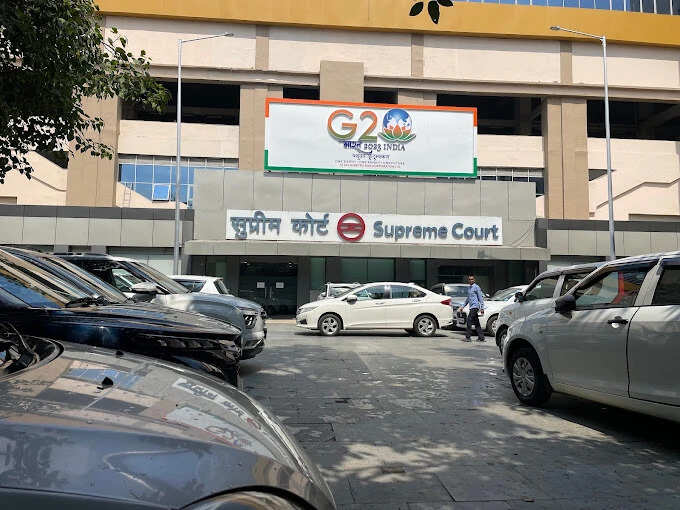
The bench made it clear that the “country cannot remain a prisoner of the past.” It observed that selectively invoking history could create divisions”.
What’s in a name? Perhaps everything.
You are still in that metro coach. The announcement has passed, the doors have opened and closed, and the train has moved on.Centuries ago, William Shakespeare wrote in Romeo and Juliet:
“What’s in a name? That which we call a rose,By any other name would smell as sweet.”
William Shakespeare
The line suggests that essence matters more than labels. Yet in modern India, names are rarely just labels. They carry history, memory, politics and identity. From Calcutta becoming Kolkata to Aurangabad being renamed Chhatrapati Sambhaji Nagar, each decision is framed as restoration, assertion or correction.
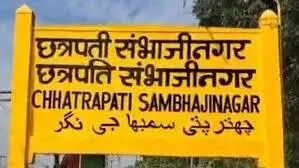
But even as official notifications are issued and signboards replaced, conversations at tea stalls, in homes and on public transport often tell a different story. Banaras survives in speech. Allahabad slips into daily vocabulary. Old and new coexist.In India, names often carry layers of history, memory and identity. They are reflections of power, pride, protest, policy and perception. They can unify, divide, restore or rebrand. They can cost hundreds of crores or just a few strokes of ink in a gazette. But they always mean something.So the next time the metro announcement echoes through the coach, whether it says Supreme Court or Sarvochh Nyayalaya, the question may not simply be what the station is called.It may be what we choose to remember when we hear it.