Shubhanshu Shukla, IISc-IISER team, find how brick-building bacteria react to toxin in Martian soil | India News
BENGALURU: A toxic chemical long considered hostile to life on Mars, may not be an obstacle to building on the Red Planet after all. Instead, it could turn out to be an unlikely aid. Researchers at IISc, working with scientists at IISER-Kolkata and Isro astronaut Shubhanshu Shukla, have found that perchlorate, a chlorine-based compound known to stress living cells, can strengthen bacteria-made “space bricks” under the right conditions.“Mars is an alien environment. What is going to be the effect of this new alien environment on Earth organisms is a very, very important scientific question to answer,” Aloke Kumar, associate professor, mechanical engineering at IISc and corresponding author, says.
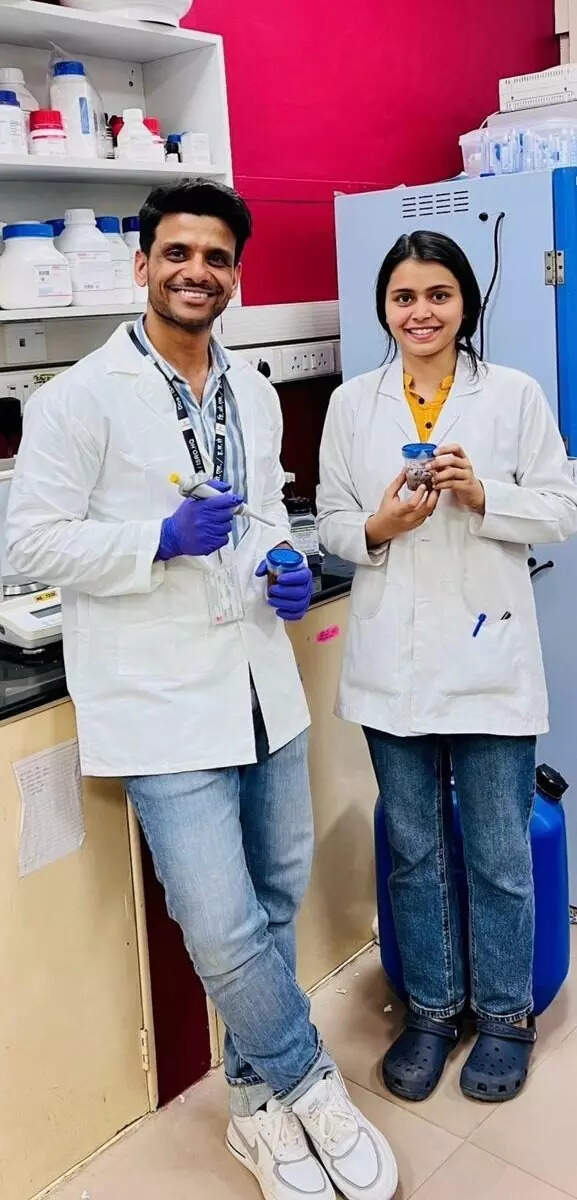
Shukla with lead author Swati Dubey | Credit: Aloke lab, IISc
Perchlorates have been detected at several Martian landing sites and are considered hostile to life. They interfere with microbial growth and pose health risks to humans. For scientists exploring biological routes to construction on Mars, the compound has long been seen as a constraint that must be eliminated or avoided. The new study, however, points to a more complex interaction between chemistry, biology, and soil.The team focused on bacteria that can bind loose soil into solid blocks through biocementation. In earlier work, IISc researchers showed that the soil bacterium “Sporosarcina pasteurii” can produce calcium carbonate crystals that glue together particles of lunar or Martian soil simulants. The process requires urea, calcium, and guar gum, a natural polymer that supports bacterial survival.In the new study, published in PLOS One, the researchers used a more robust bacterial strain isolated from soils in Bengaluru. After confirming its mineral-forming ability, the team examined how it responded to perchlorate levels comparable to those measured on Mars, reaching up to about one per cent.The biological response was studied in collaboration with IISER-Kolkata, where Professor Punyasloke Bhadury’s group examined how perchlorate alters cell behaviour. The bacteria grew more slowly, became rounder in shape, and began clumping together, all clear signs of chemical stress. They also released higher levels of proteins and other molecules into their surroundings, forming an extracellular matrix.
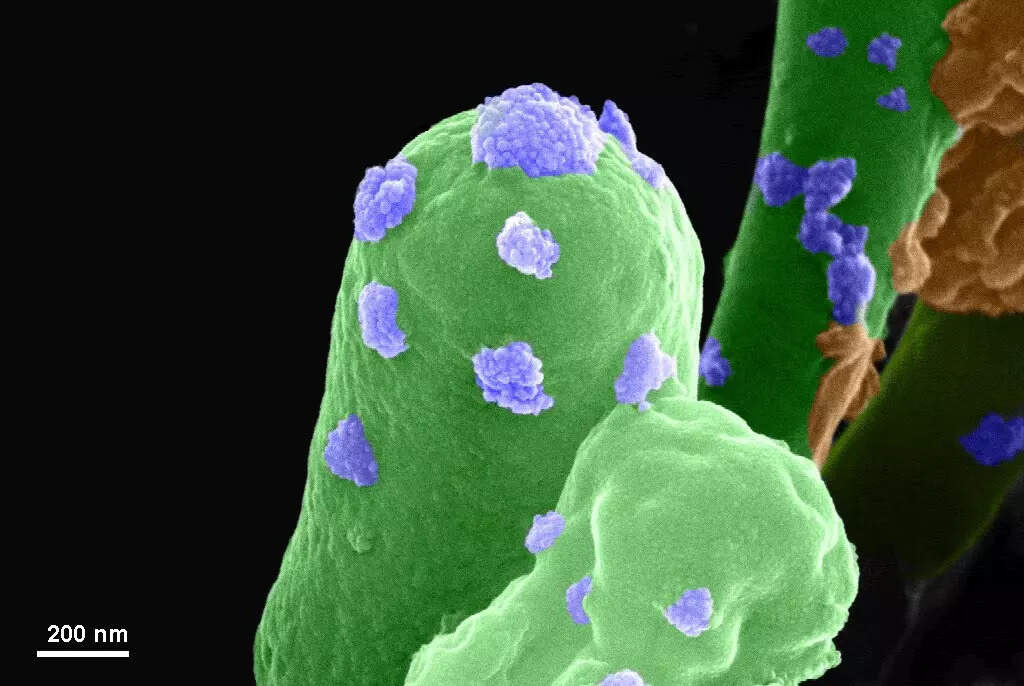
Microscopy image of Sporosarcina pasteurii | Credit: Aloke lab, IISc
When these stressed bacteria were added to synthetic Martian soil in the lab, the outcome surprised the researchers. With guar gum and a small amount of nickel chloride present, the resulting bricks were stronger than those produced without perchlorate. Microscopy revealed more mineral precipitates and fine “microbridges” formed by the extracellular matrix, linking bacterial cells to soil grains and minerals.“When the effect of perchlorate on just the bacteria is studied in isolation, it is a stressful factor. But in the bricks, with the right ingredients in the mixture, perchlorate is helping,” says IISc’s Swati Dubey, the study’s first author. Ultimately, the team’s goal is to deploy this method as an alternative, sustainable building strategy, to rely less on carbon-intensive cement-based processes – both on Earth and Mars. Co-author of the study, Shukla, who is pursuing his Master’s degree with Kumar at IISc, says such technologies can also help make future Mars landing missions smoother, by helping build better roads, launch pads, and rover landing sites. “The idea is to do in situ resource utilisation as much as possible. We don’t have to carry anything from here; in situ, we can use those resources and make those structures, which will make it a lot easier to navigate and do sustained missions over a period of time,” ,” Shukla added.